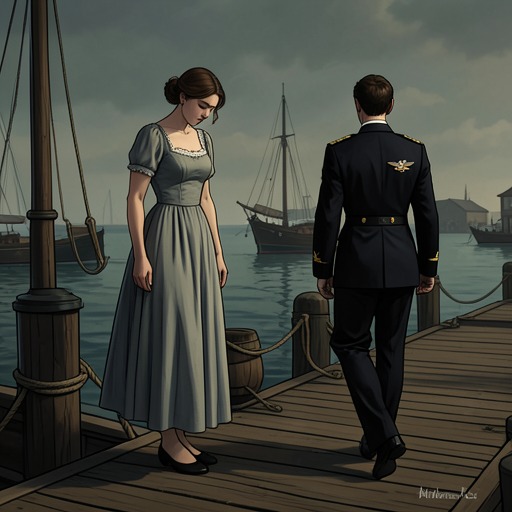
Willie Keith Breaks Up with May Wynn
The Caine Mutiny Court-MartialWillie Keith Breaks Up with May Wynn is a separation shaped by a contradiction Willie can recognize but cannot resolve: he longs for May, yet believes he will never marry her. Granted leave before the court-martial, he goes to New York to end the relationship face to face, accepting that the encounter will hurt them both. Their final conversation turns his private decision into an acknowledged parting, but its closing gesture—a long kiss before May sends him away—also exposes how much attachment remains beneath the break.
Leave and the Decision to End the Relationship
Willie is already on his way to New York by plane when the episode opens. Captain Breakstone has advised the Caine’s new commanding officer to let him go, and a legal officer has argued that Willie should have ten days before the court-martial begins. The leave is therefore a temporary interval before an uncertain legal and personal future. Willie, however, has one specific purpose for using it: he is going home to break with May.
The decision follows what the narration describes as a change in Willie’s thinking over the turbulent months before his leave. He now sees his conduct toward May, including their correspondence, as abominable. He still yearns for her and considers that he may love her, but he has become convinced that he will not depart from his upbringing far enough to marry her. That distinction—between feeling and the life he is willing to choose—drives the separation. He regards May as the person most harmed by the unresolved relationship and decides that silence or a letter would not be an adequate ending. He must face her and accept the pain she may cause him in return.
The Future Willie Chooses
Seeing May again confirms Willie’s resolve, even as it makes the emotional cost harder to ignore. He measures himself with little pride as a mediocre, middle-class intellectual whose ambition extends only to a comfortable life as a professor at a respectable university. He wants the material ease that money can provide, and imagines it coming from his mother or a wife rather than from academic work. His imagined wife belongs to his own social world: well-bred, educated, attractive, and financially secure.
Against that ideal, Willie judges May through assumptions about class, appearance, sexuality, and religion. He recognizes her brightness and powerful attraction, but also dismisses her as vulgar and show-business brassy, and treats their sexual intimacy as a mark against her. Her Catholic background adds another anxiety: although she has disclaimed strong religious devotion, he suspects she might return to the faith and fears the consequences for a future marriage and children. These judgments do not establish that May is unsuited to him; they reveal the standards Willie is unwilling to abandon. He even acknowledges that the trouble between them lies with him, while still acting on his belief that their lives would not fit together.
The circumstances of their reunion intensify his judgment. May is sick, broke, and staying in a shabby hotel room; the schoolbooks around her make her seem more pathetic to him rather than more desirable. He recognizes that she has tried, unsuccessfully, to reform herself closer to his tastes. The narration leaves open whether his resolve might have wavered had she returned as a triumphant musical-comedy star. In the room before him, however, her vulnerable condition reinforces his decision. The contrast between the polished future he imagines and the impoverished, imperfect present he sees becomes part of the breakup’s painful imbalance: Willie treats his own aspirations as a fixed plan and May’s circumstances as evidence against her.
The Conversation That Makes the Break Explicit
Willie does not tell May about the mutiny. Instead, he entertains her with stories about Captain Queeg, and she laughs and gasps at them. After May recovers, the evening passes in restrained, good-humored, evasive conversation. Willie’s manner keeps the central issue at a distance until they return to her hotel room late at night. There, both are tired, but they kiss hungrily; May’s forehead and hands feel hot to Willie, and he continues kissing her before they stop together.
May asks, “Willie, we’re all washed up, aren’t we?” He does not need to answer aloud: she reads the decision in his face. When she asks why they are kissing if the relationship is over, Willie calls himself a swine and agrees to stop. The encounter reveals the gap between his desire and his intended action. His physical tenderness has not disappeared, but it cannot promise the future May needs to understand what the relationship means.
May asks whether he loves her and presses him to explain the contradiction between his kisses and his decision. Willie cannot give her a clean explanation. He says he does not know what love is, acknowledges that she will remain an image of desire for him, and insists that desire is not enough to make them happy together. He calls himself a snobbish prig and says that what is wrong between them is wrong with him. May tries to make the reason concrete, asking whether it is her poverty, intelligence, or religion. The exchange leaves no simple answer that would make the rejection fair or painless: Willie can name his own failings, but naming them does not undo the choice he has made.
Farewell and Willie’s Misreading
Willie tells May that he is leaving at seven the next morning. Before he goes, she bolts the hotel-room door, explaining that the musicians who work there are exceptionally nosy, then embraces him. They share a long, blind, wild kiss. May ends it herself, pushes him out of her arms, and tells him to remember it for the rest of his life. Having said that it hurts to have him near her, she opens the door; Willie walks out through the jostling dancers and into the street. Her farewell grants the moment intensity without turning it into reconciliation. She both participates in the last kiss and insists that he leave.
Even afterward, Willie does not fully understand why he came. He blames himself for a late surge of desire disguised as a need for advice, but cannot recognize the more ordinary impulse described by the narration: a husband’s wish to talk things over with his wife. That comparison does not change his decision, but it shows that the separation is not emotionally complete in his own mind. He has ended the relationship in action while remaining unable to comprehend the form of closeness he may still have wanted.
The following morning, Willie’s plane departs on schedule beneath a sunny sky. His mother waves from the sightseeing boardwalk as it rises. Looking down at Manhattan, he tries to locate the Hotel Woodley among the city’s dingy midtown buildings but cannot find it. The failed search gives the departure a final, concrete image: he is leaving the place where the breakup occurred, yet cannot pick out its location from above. May’s demand that he remember the kiss and Willie’s inability to see the hotel hold together the episode’s unresolved ending—deliberate separation on the surface, continuing desire and incomplete understanding beneath it.